
Rent vs Buy If Moving in 3 Years. Most people who buy a home with a short time horizon believe they’re making a “safe” decision.
They ran a calculator.
The monthly payment looked manageable.
Home prices usually go up.
That logic is precisely how regret is manufactured.
This audit explains why buying with a 2–3 year horizon is one of the most fragile financial decisions you can make—and why standard buy vs rent tools systematically fail to warn you.
This is not advice.
It’s a risk audit.
Why Short Time Horizons Break Ownership Math. Rent vs Buy If Moving in 3 Years.
Homeownership is not linear.
The early years of a mortgage behave very differently than the later ones. In the first 36 months, ownership is dominated by:
- front-loaded interest
- unrecoverable transaction costs
- maintenance drag
- capital lock-up
Very little of your payment builds usable equity.
Yet most calculators treat every year as equal.
They are not.
Rent vs Buy If Moving in 3 Years: Decision Risk Comparison
When evaluating rent vs buy if moving in 3 years, the decision isn’t about preference—it reflects structural risk.
The comparison below shows why short time horizons quietly punish ownership math.
| Decision Variable | Renting (3 Yrs) | Buying (3 Yrs) | Why This Matters |
|---|---|---|---|
| Time Horizon Fit | Naturally aligned | Structurally fragile | Ownership math assumes long holding periods to amortize costs. |
| Front-Loaded Interest | None | High (Years 1–3) | You pay almost exclusively interest in the first 36 months; little principal reduction. |
| Upfront Cash | Security Deposit | Down Payment + Closing | Capital lock-up creates massive Opportunity Cost in the stock market. |
| Monthly Payment Risk | Predictable | Volatile | Owners are sensitive to Taxes, Insurance hikes, and sudden Repairs. |
| Maintenance (CapEx) | Landlord Absorbs | Buyer Absorbs | Replacing a water heater in Year 2 destroys your short-term ROI. |
| Selling / Exit Costs | None ($0) | 6–10% of Value | Agent fees and closing costs will likely eat all your appreciation. |
| Price Decline Risk | Minimal | High Exposure | A small 5% market drop wipes out your down payment equity (Leverage Risk). |
| Liquidity Flexibility | High | Low | You cannot “sell a bedroom” if you need cash. Real estate is illiquid. |
| Opportunity Cost | Investable Capital | Trapped Capital | Missed compounding growth on your down payment over 36 months. |
| Break-Even Likelihood | High | Low | Mathematically, most buyers do not reach break-even until Year 5-7. |
| Regret Risk | Low | Elevated | The risk profile is asymmetric; buying short-term has high downside. |
Stop Guessing. Audit the Risk
The Front-Loaded Interest Trap

In the first 2–3 years of a typical mortgage:
- the majority of your payment goes to interest
- principal reduction is minimal
- equity growth is highly sensitive to price movement
This means your break-even point is pushed far into the future, often well beyond your planned move date.
If prices stagnate—or fall even slightly—your equity becomes fragile.
Selling Costs Most Buyers Don’t Model
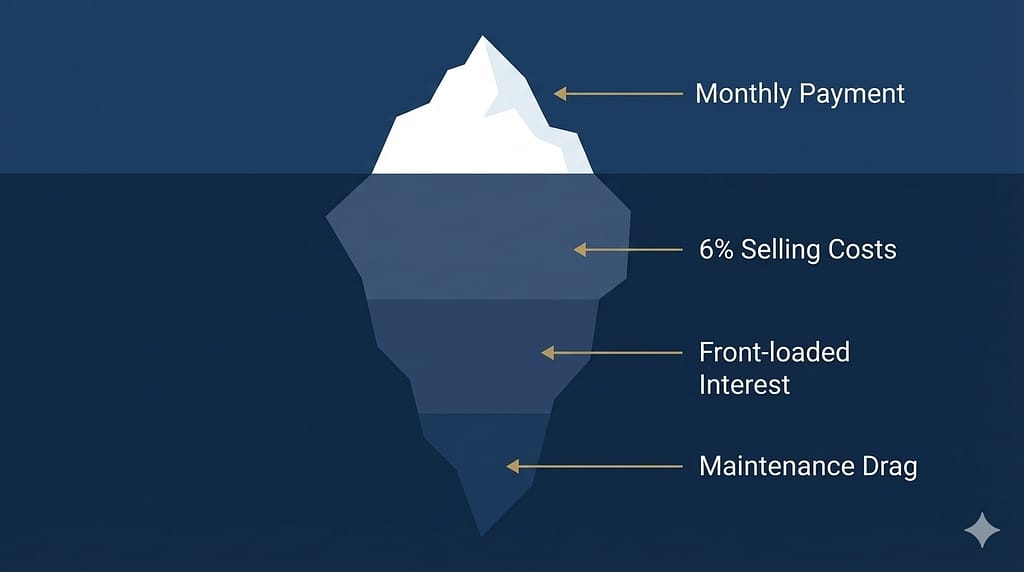
When buyers run “rent vs buy” math, they almost never include the cost of exiting.
Selling a home typically involves:
- agent commissions
- transfer taxes
- staging, repairs, and concessions
- time risk (selling slower than expected)
These are unrecoverable costs. They do not compound. They do not build wealth.
On a short horizon, they dominate the outcome.
Opportunity Cost Over 36 Months
This is the variable free calculators ignore entirely.
Capital used for:
- down payments
- closing costs
- excess monthly ownership costs
is capital that cannot compound elsewhere.
Over three years, this opportunity cost may not feel dramatic—but it quietly widens the gap between renting and buying, especially in flat or volatile markets.
Opportunity cost doesn’t show up as a bill.
It shows up as missing growth.
Stress Test Thought Experiment

Let’s remove optimism.
What happens if:
- prices are flat for three years?
- prices decline 5–10% by Year 3?
In these scenarios:
- early equity evaporates
- selling costs become punitive
- renters preserve liquidity
- buyers absorb asymmetric downside
Most buyers never run this simulation.
They assume appreciation will rescue the math.
That assumption is the risk.
The Only Variables That Actually Matter Here
If your horizon is under three years, the decision hinges on just a few variables:
- interest rate level
- transaction and exit costs
- rent-to-price ratio
- opportunity cost of capital
- downside price sensitivity
Lifestyle arguments don’t change these numbers.
Hope doesn’t change these numbers.
Math does.
What This Audit Is Not Saying
This audit is not claiming renting is always better.
It is not claiming buying is reckless.
It is saying that short horizons amplify risk, and most people underestimate how quickly ownership math can break.
The danger isn’t buying.
The danger is buying blind.
Rent vs Buy If Moving in 3 Years — Common Questions
Q: Is it ever worth buying a home if I plan to move in 3 years?
A: It can be—but only under narrow conditions. Short time horizons amplify front-loaded interest, selling costs, and price risk. Unless appreciation, rent-to-price ratios, or opportunity cost clearly favor ownership, buying within a three-year window is structurally fragile. Most generic calculators fail to model this risk accurately.
Q: How long does it usually take to break even when buying a home?
A: For many markets, break-even occurs well beyond three years—often closer to 6–10 years. Early mortgage payments are dominated by interest, and selling costs can erase several years of equity. That’s why time horizon is one of the most important variables in any rent vs buy analysis.
Q: What is the biggest financial risk of buying if I move in 3 years?
A: The largest risk is asymmetric downside. Even a modest decline in home prices can eliminate early equity, while selling costs remain fixed. Renting limits downside exposure, while buying concentrates risk during the most fragile phase of ownership.
Q: Do rising home prices make buying safer in the short term?
A: Rising prices can mask risk—but they don’t remove it. Short-term buyers rely heavily on appreciation to offset interest and exit costs. If appreciation slows or reverses, the math breaks quickly. Decisions that only work in optimistic scenarios are inherently risky.
Q: How does opportunity cost affect the rent vs buy decision over 3 years?
A: Opportunity cost reflects what your capital could earn elsewhere instead of being locked into a home. Down payments, closing costs, and higher monthly ownership expenses reduce investable capital. Over three years, this hidden cost can materially change the outcome—yet most calculators ignore it entirely.
Q: Are free rent vs buy calculators reliable for short time horizons?
A: Most are not. Many assume linear cost behavior, constant appreciation, and minimal exit costs. Short horizons require non-linear modeling, stress testing, and opportunity cost tracking—features typically absent from free tools.
Q: Does renting for 3 years mean I’m “throwing money away”?
A: No. Renting exchanges flexibility and liquidity for shelter. Whether that trade-off is favorable depends on time horizon, market conditions, and opportunity cost. In short-term scenarios, renting can preserve capital and reduce regret risk.
Q: What variables matter most if I’m deciding between renting and buying short-term?
A: The most critical variables are:
interest rate level
rent-to-price ratio
transaction and selling costs
opportunity cost of capital
sensitivity to price declines
Lifestyle preferences don’t change these inputs.
Q: How can I evaluate my own rent vs buy scenario accurately?
A: You need a model that accounts for:
front-loaded interest
unrecoverable costs
opportunity cost
downside price scenarios
A risk audit shows where and when regret appears—before you commit.
Run the Risk Audit
Short time horizons demand higher certainty.
If you’re moving within three years, intuition isn’t enough.
Stop Guessing. Audit the Risk
Disclaimer
BuyVsRentPro is a financial education platform, not a licensed financial advisor. All outputs are estimates based on user inputs and historical data. Consult qualified professionals before making financial decisions.
References & Further Reading
Considering a move in just a few years? These trusted resources provide additional perspectives on the rent vs buy decision, short-term housing economics, and financial tradeoffs.
- 📖 Zillow – Pros and Cons of Renting vs Buying Consumer-friendly breakdown of renting vs buying, useful for short timelines.
- 💡 MoneyGeek – Rent vs Buy Guide Detailed comparison of upfront costs, monthly payments, and long-term impacts.
- 🏠 Redfin – Renting vs Buying a House Practical pros and cons, lifestyle considerations, and financial tradeoffs.
- 📊 Investopedia – Rent vs Buy Overview Authoritative financial literacy article explaining rent vs buy tradeoffs.
- 📑 Freddie Mac – Renting vs Owning Study Data-driven analysis of affordability shifts using transaction data.